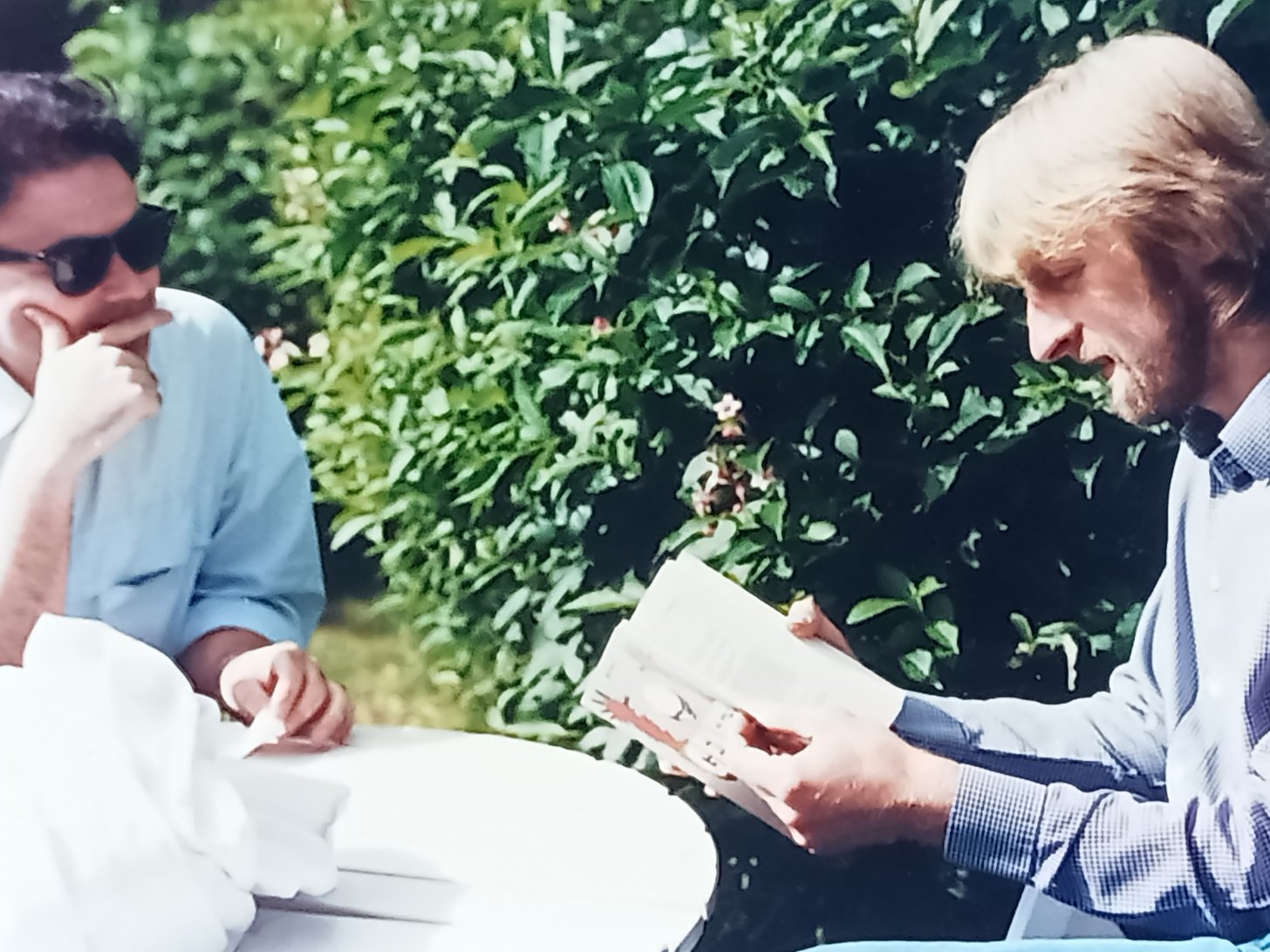
TWR interviews the founder of Italian fanzine Dusk, Mario Giammetti. Photos by Alan Hewitt.
TWR: How did you become a Genesis fan and what attracted you to the band?
MG: The first time I ever heard Genesis was as a kid. I was on vacation at the beach, and a guy I'd met there, about three years older than me, played "Watcher of the Skies" on the beach jukebox (I'd only discover years later that it was a special version, missing the instrumental intro and outro). I was especially struck by the rhythm and atmosphere, but I only really got to know Genesis a few years later, in 1978, with "And Then There Were Three." I can't explain the reasons, but from the first listen, I fell madly in love with that music: Phil's voice, those enveloping keyboards, those intertwined guitar sounds... I loved the whole album, but my favourite song was "Burning Rope."
As soon as I could, I tried to find out more about that band, and as you can imagine, it was one revelation after another: I never would have thought that their previous albums, which I obviously quickly got, could be even better. Moreover, the early Genesis releases, compared to the 1978 album, had a stronger classical feel, which was even more in keeping with my tastes, given that at the time I really appreciated Italian bands playing progressive rock (even if no one called it that yet), like PFM, Orme, and New Trolls.
TWR: When did you see the band in concert for the first time?
MG: As you well know, Genesis played extensively in Italy in the early '70s, but I was still too young at the time. And those were difficult years for my country: during a Led Zeppelin concert in Milan, there were violent clashes between protesters and police, who had to use tear gas, forcing Page and Plant's band to end the show early. A few years later, further protests occurred during a Santana show. The result was that Genesis, like most international artists, stayed away from Italy for a few years. In fact, after the Turin concert on The Lamb tour, the band returned to Italy only in September 1982, and it was in Rome on the 7th that I finally managed to live that great emotion. I still remember the chills when Phil introduced "una vecchissima vecchissima canzone” (“a very old, very old song") and the notes of "Supper's Ready" began. Before then, however, I had had the opportunity to attend Peter Gabriel’s show in Florence in 1980 and Steve Hackett’s in Rome in 1981: by then, I had already obtained not only the band's discography, but also most of all the solo albums released up to that point.
TWR: Of all the Genesis gigs you've seen, which one stands out in your memory and why?
MG: Gabriel's concert in Florence in September 1980 is the one that sticks out in my memory the most. Partly, I admit, because it was my first ever concert by a Genesis family member, so it was special. But also because Gabriel was extraordinary at the time, very different from the hyper-technological figure he would become in the years to come. Five musicians showed up (with him were Fast, Marotta, Ellis, and Giblin), dressed sportily and without any grand stage sets, even though Peter was obviously already full of brilliant and original ideas, and they unleashed a sonic power and intensity that I never found again in any of the next Gabriel's many tours.
As for Genesis, I'm obviously attached to the first one I saw, the one in Rome in 1982. Alternatively, I particularly fondly remember two closed-door, invitation-only concerts, which you were also present at: the one in Bray in 1998, a dress rehearsal for Ray Wilson, who raised hopes for a new, long artistic phase for the band, and the one in Brussels in 2007, where we witnessed the return of Phil Collins. I don't have a particularly vivid memory of the Rome concert in 2007 (too many people, too much chaos), and I chose not to see the Last Domino tour.
Of course, I've also seen many concerts by the solo members of Genesis, and I have always enjoyed them. Among many, Hackett at Castel Sant'Angelo (Rome) in 1981 was memorable, and I loved Phil in Milan in 1997 with his colourful band (although I was negatively surprised by the duet with Italian singer Laura Pausini in "The Same Moon"), the always fun and engaging Mike & The Mechanics, both in the old lineup with Carrack and Young (London 1999) and with Roachford and Howar (Munich 2016), and also Ray Wilson, even though his concerts are, for obvious reasons, more subdued and less spectacular, but that doesn't mean they aren't exciting.
TWR: You established Dusk as the fanzine for Italian fans in 1991. Why did you decide to do this?
| MG: In the summer of 1990, I took my first trip to London and, on that occasion, I went to Anthony Phillips's house. The Internet didn't exist at the time, so I showed up unannounced. He, although surprised, was very kind. He browsed with interest through my first book on Genesis (which I had published two years earlier, in 1988). Since I had already been contributing to Ciao 2001, a wonderful Italian music magazine where Armando Gallo had also begun his journalistic career, he agreed to an interview, which we conducted a few days later. When I returned to Italy and proposed the interview to the magazine, they only gave me two pages, so I wondered what I could do with the rest of the long conversation, given that we had spoken for almost an hour and a half and I had asked him every question you could imagine. More for fun than anything else, I thought of preparing the first issue of a fanzine in March 1991 that I called Dusk: a few photocopied pages, folded in half and stapled in the centre, which I advertised in Ciao 2001, promising to send a sample to anyone who sent me a stamp! My initiative attracted moderate interest, so I decided to give it a try for a while and see what happened. At the time, I wasn't aware of either the official Genesis Information fan club or The Waiting Room: I discovered these both months later, as well as the German fanzine Invisible Touch / it, but I made up for lost time by subscribing and picking up all the back issues, little by little. After Dusk's first year, I realized that there was still some interest among Genesis fans in Italy, unlike the mainstream media which, after having so appreciated the band during the Gabriel period, were decidedly colder towards the Collins period. And so Dusk continued, and we've just entered our thirty-sixth year! | |
TWR: Which band member did you meet first?
MG: The first was Anthony, as I mentioned above. The following year, I made a similar attempt with Steve: I didn't find him at home, but I had the opportunity to interact with his manager at the time. So one more year later, in 1992, I also arranged a long interview with Steve, and an excerpt of that was again published in Ciao 2001. After that, I naturally had the opportunity to meet everyone and interview them, even face-to-face, with the sole exception of Peter Gabriel, who never granted me an exclusive interview, although I asked him a few questions during a few press conferences or roundtables over the years.
TWR: Your first book, “Genesis Discografia 1968-1993”, was published in 1994. What made you write it?
MG: Actually, my first book was from 1988 and is titled “Genesis Story”. The motivation that led me to write it, a total unknown as I was at the time, was that I felt a book was needed in Italy that focused more on Genesis's extraordinary music, given that their biography had already been explored in an unbeatable manner by Armando Gallo. So in that book, after a brief historical section, I reviewed all Genesis's songs in alphabetical order, before dedicating a chapter to each of the solo members. In fact, six names appeared on the cover of that book, including Anthony Phillips, who was delighted when I handed him a copy during that meeting two years later I mentioned earlier. The fact is that even then, in my opinion, one of the main reasons for Genesis's greatness lay in their diverse individualities, all endowed with extraordinary creativity.
“Genesis Discografia 1968-1993” was released a few years later and was essentially a collection of data, an attempt to put on paper the discography (singles, albums, anthologies, even bootlegs and videos) of all the members of Genesis. A small-format book that obviously wouldn't make sense today, with the power of the internet, but which at the time became a rather interesting guide for enthusiasts.
Then, in 1999, it was the turn of “Peter Gabriel – Il trasformista”.
TWR: You followed that in 2004 with “The River Of Constant Change” and have since then produced volumes on each of the solo members, what have been the challenges in writing these?
MG: “Il Fiume del Costante Cambiamento” was a step forward in my writing, as in the meantime I had gained an extensive critical experience working for various Italian music magazines and was thus able to approach Genesis's musical material in a much more scholarly and in-depth manner. It was a very substantial book (480 pages), with many previously unpublished black-and-white photographs, and it's also right to highlight the crucial contribution of Mino Profumo and Alessandro Berni, who wrote the extensive appendices on Genesis's tours for that volume.
In 2005, I embarked on the "Genesis Files" series, for which I must give due credit to a visionary editor, Piero Mantero of Edizioni Segno, who sadly passed away prematurely. Seven volumes were published in total, one for each member of Genesis, over the course of eleven years. The series opened with the Phil Collins book and closed with the one on Peter Gabriel, the only one without an appendix. The other six volumes, in fact, include contributions from collaborators who delve into a specific aspect of the protagonist, such as Phil's sessions, Steve's gear, Ant's library, and so on. The appendix to volume 6, dedicated to Ray Wilson, is particularly noteworthy, with ten short chapters dedicated to the live and studio musicians Genesis session players (from Thompson and Stuermer to Nir Z and D'Virgilio).
Writing all these books was a great challenge, and it was truly wonderful, each time, to immerse myself in the work and personalities of these awesome artists, with the opportunity to also tap into many of their collaborators to create the most comprehensive picture possible.
TWR: Have the band members been receptive to your work?
MG: Certainly, albeit to varying degrees. Phillips and Hackett, with whom I'm proud to have built a personal relationship over the years, have always supported my work and have always been very collaborative. Tony and Mike wrote the forewords to my first two books in English, respectively, while Phil mentioned my book dedicated to him in the forum of the old Genesis website, but said he hadn't read it (after all, it was in Italian, how could he?).
TWR: How do you go about writing a book such as these, what comes first? How do you go about organising your ideas and information?
MG: I begin by rereading dozens of books, magazines, and clippings from old articles, taking notes along the way. And of course, I do research online; it's obvious that the internet, while definitely not the Bible that many believe, is an invaluable source of information. Then I listen to everything there is to listen to, and I take notes there too.
In all my books, alongside historical, biographical, and anecdotal notes, I always give particular importance to the purely musical (not necessarily technical) aspects, in the belief that what made and continues to make Genesis unique for all of us is, more than anything else, the wonderful music they composed.
TWR: At last your work is appearing in English language editions, the two volume adaptation of “The River Of Constant Change” which appeared as “Genesis 1967 to 1975 - The Peter Gabriel Years” and “Genesis 1975 to 2021 - The Phil Collins Years” (subsequently updated to 2025) appearing first. Considering how detailed the original Italian volume had been, what extra detail did you bring to it's English counterparts, and why did you expand the latter volume up to 2025?
MG: Actually, the two volumes in English you mentioned are not adaptations of “Il Fiume / The River”… but something completely different. While in the 2004 Italian book I used a wide variety of sources (so many that, unfortunately, I wasn't able to identify and credit them correctly, for which I apologized in the introduction), in the two English volumes (the first of which is the translation of “Gli Anni Prog”, published in Italy in 2013) I used exclusively statements from Genesis members given to me and to Mike Kaufman, the journalist who interviewed them for the 2007/2008 remasters, who kindly provided the full transcriptions (while the bonus content on the DVDs of those reissues obviously only used a portion of the statements). The structure of these two English language books is also different, with a song-by-song review (each supplemented by Genesis' own words), my albums critique contextualized to the era of their respective releases (thus placing Genesis's work within the broader rock scene of the period), and then the live section.
As for the second edition of the book on the Collins period, the decision taken together with the London publisher Kingmaker was determined by the fact that the first edition, the one that finished with the announcement of the Genesis final tour, it had long been sold out. Rather than simply reprinting it with a few minor corrections of previous errors (as we did with “The Peter Gabriel Years”, which has been published in three runs), we thought it was right to add a couple of chapters and also talk about the Last Domino tour.
TWR: Your book on Tony Banks, Man of Spells was published in 2006 and has now been translated into English and expanded. What extra details have you brought to the English edition?
| MG: Again, although the Italian version was also titled “Man of Spells”, it's not a simple translation, except for the two technical appendices written by Alessandro Berni and Francesco Gazzara: those, aside from a few minor updates, effectively contain the same content, simply translated into English. But as far as the main text is concerned, we're talking about two different books, even if it's clear that in some chapters the starting point is similar. But the Italian version came out in 2006, twenty years ago: aside from everything that's happened since then in Tony’s life and career (including two completely new classic albums), by 2006 I had only interviewed him three times. For this English book, the interviews with Tony have grown to 14, and over the years, I've asked him not only about his latest releases, but about his entire career, particularly delving into those areas that hadn't been sufficiently clarified yet. The difference is noticeable even at a glance: the Italian book was much smaller and, aside from two colour inserts, featured few black-and-white photos inside, whereas this one is printed on high-quality paper and is full of photographic material, some of which are quite rare. | 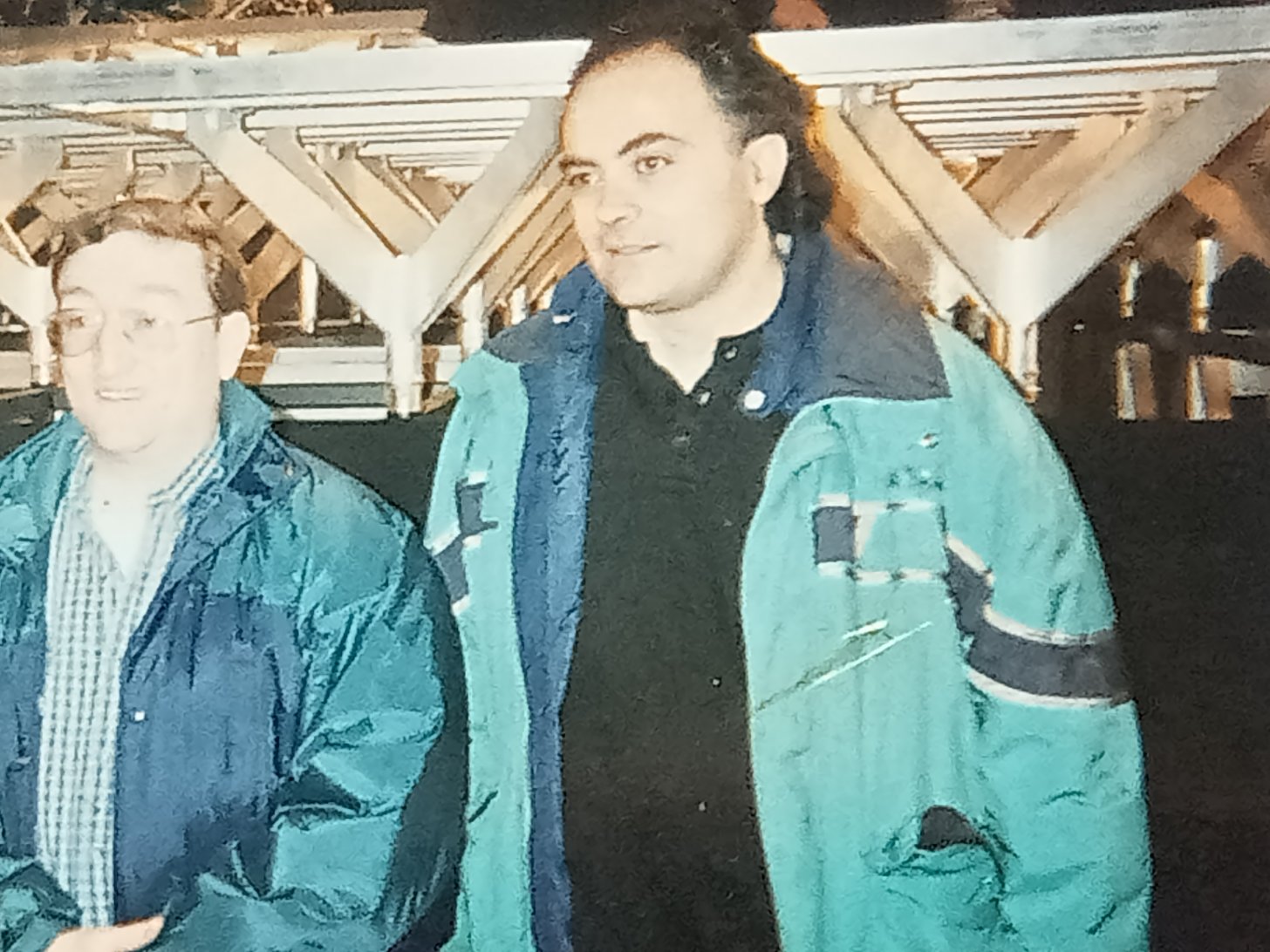 |
TWR: Of all the books you have written about the band, which has given you the most pleasure?
MG: I've put all my effort and love into each of my books. However, I definitely began to feel greater satisfaction starting with the 2004 book “Il Fiume…”, because I noticed a personal growth in my approach and the maturity of my writing and criticism. I've also used this more rigorous approach in two other books, “Musical Box. Le canzoni dei Genesis dalla A alla Z” (2010) and “Genesis. Tutti gli album, tutte le canzoni” from 2020, which is the most luxurious in terms of photography.
Otherwise, it was particularly rewarding to have the opportunity to interview at length people very close to the various protagonists. Among the many that come to mind are Steve's mother, Ant's brother, Mike's childhood friend (Dimitri Griliopulos), and Ray's brother.
However, the thrill of re-listening to all the Gabriel-era albums with one of them at my side, ready to comment on the music minute by minute, remains unparalleled: Ant did it for From Genesis to Revelation and Trespass; Steve for Nursery Cryme, Foxtrot, and Selling England; Tony for The Lamb. Re-listening to those masterpieces with the protagonists just a foot away from you is priceless!
TWR: Do you have plans for English translations of the rest of your books?
MG: What I'd really like to see is the entire “Genesis Files” series translated into English, obviously appropriately enriched and updated. But there are two major obstacles. The first is financial, because translations are expensive, and obviously a quality product requires a professional translator; the second is time: it takes a lot, and you know it well, and as Genesis themselves say in Down and Out, "none of us are getting any younger"! So we'll see what the future holds.
TWR: If you hadn't decided to dedicate so much time to Genesis, are there any other bands you would like to write about?
MG: Since I've been writing for Italian magazines continuously since 1988, for a total of around 4,000 articles published in the national press to date (I'm referring to magazines sold at newsstands, so I'm not counting Dusk nor books!), I've had the opportunity to write about countless rock artists and artists from various musical genres. I've also had the honour of personally interviewing members of Pink Floyd, the Police, Deep Purple, the Doors, King Crimson, Jethro Tull, Gentle Giant, Yes, Emerson Lake & Palmer, Moody Blues, Van Der Graaf Generator, Uriah Heep, Toto, Gong, Marillion, Caravan, Supertramp, and great artists like Robert Wyatt, Roy Harper, and Steven Wilson. And I've contributed to books co-written by numerous authors on stars like David Bowie, Queen, and Pink Floyd. In short, from this perspective, I feel very fulfilled. But for me, Genesis are and will always be the best.