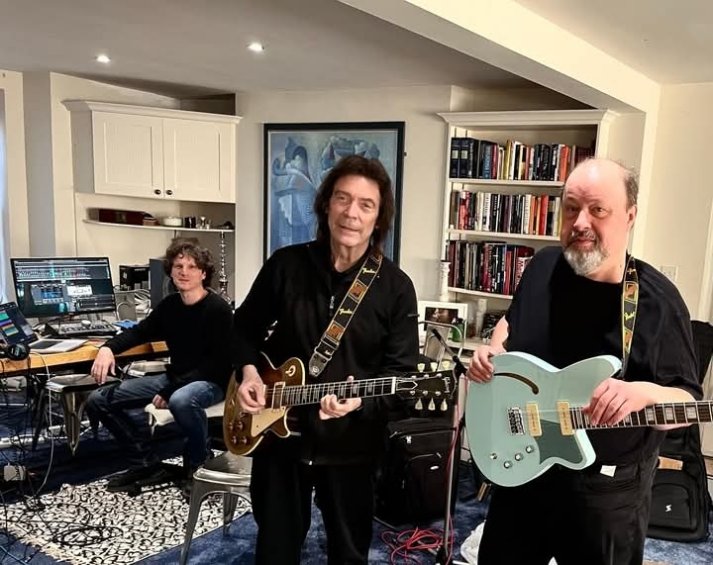
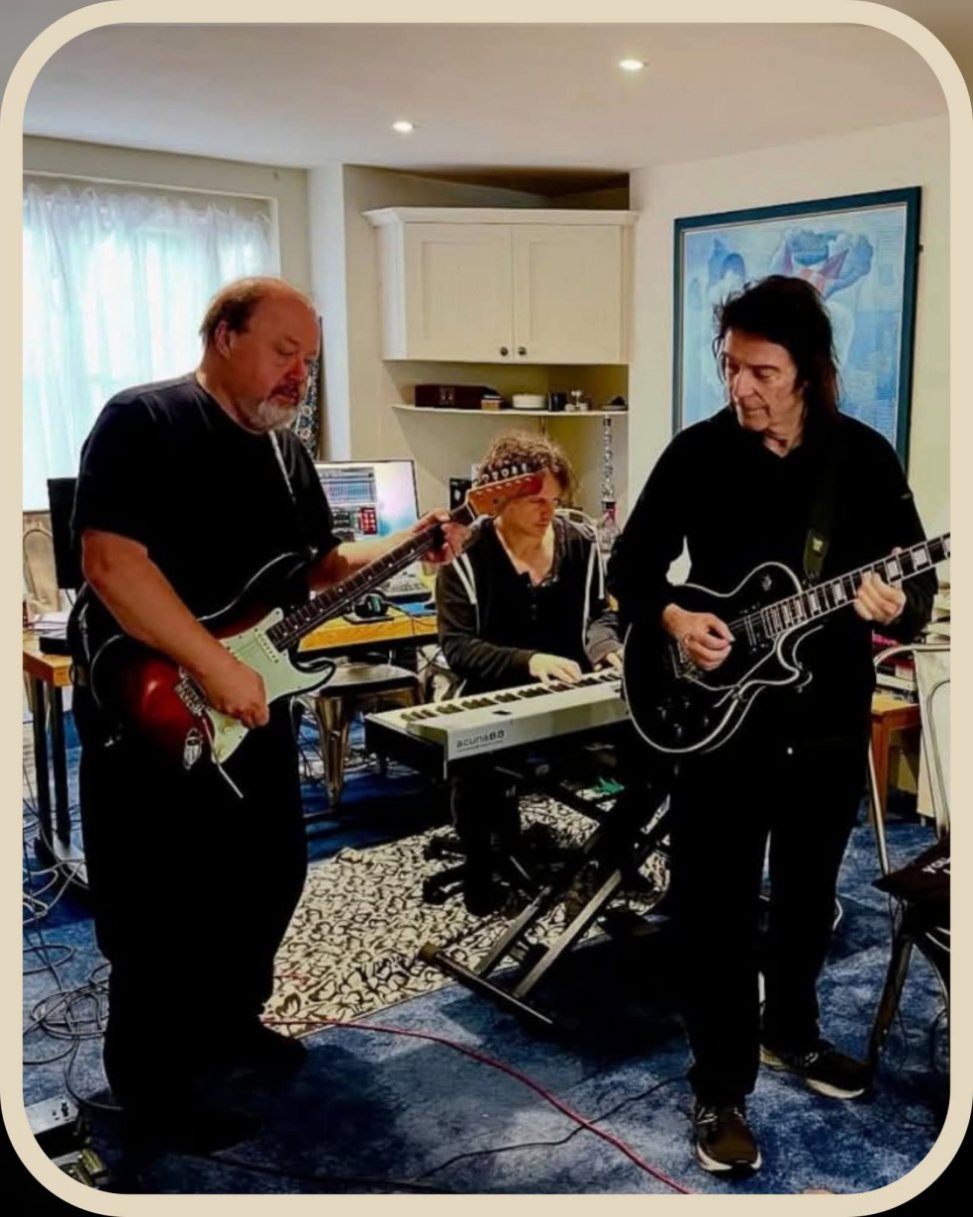
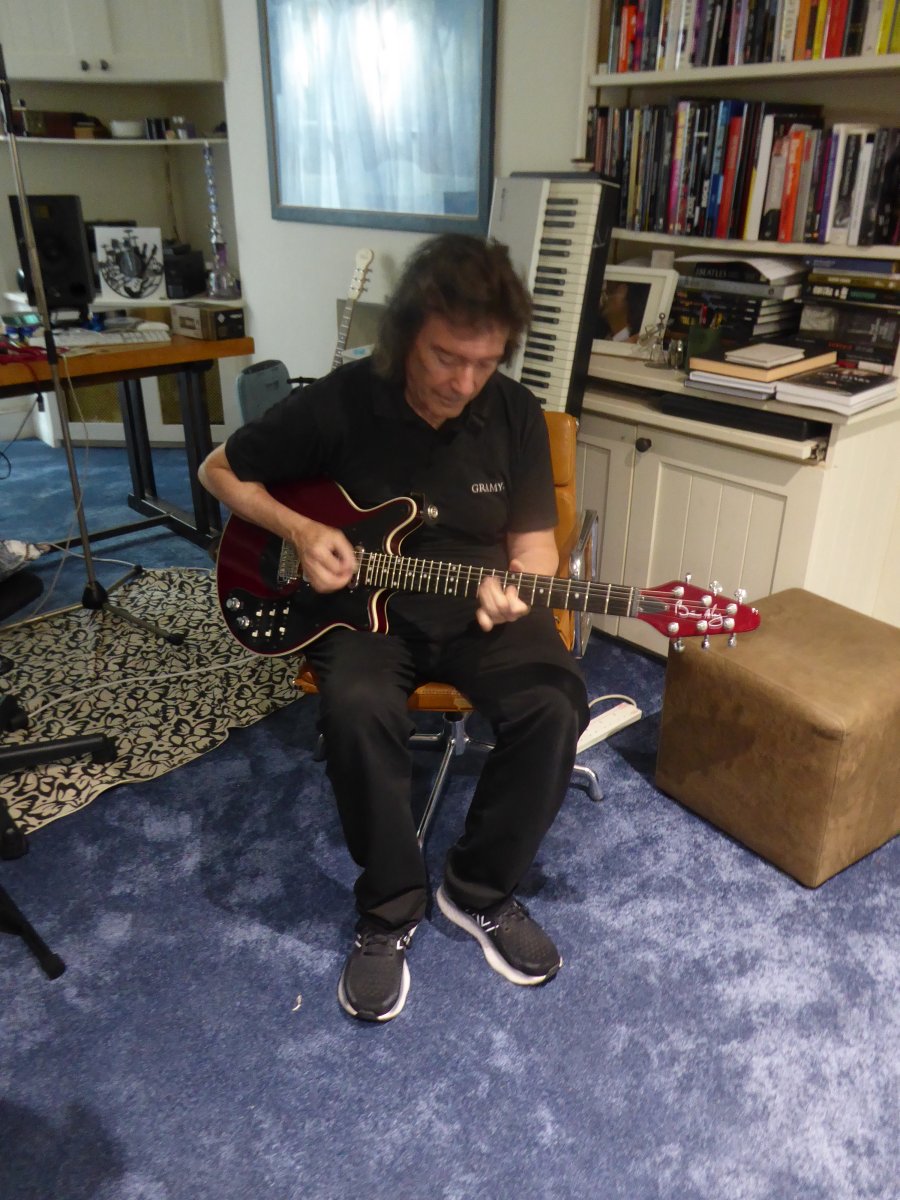
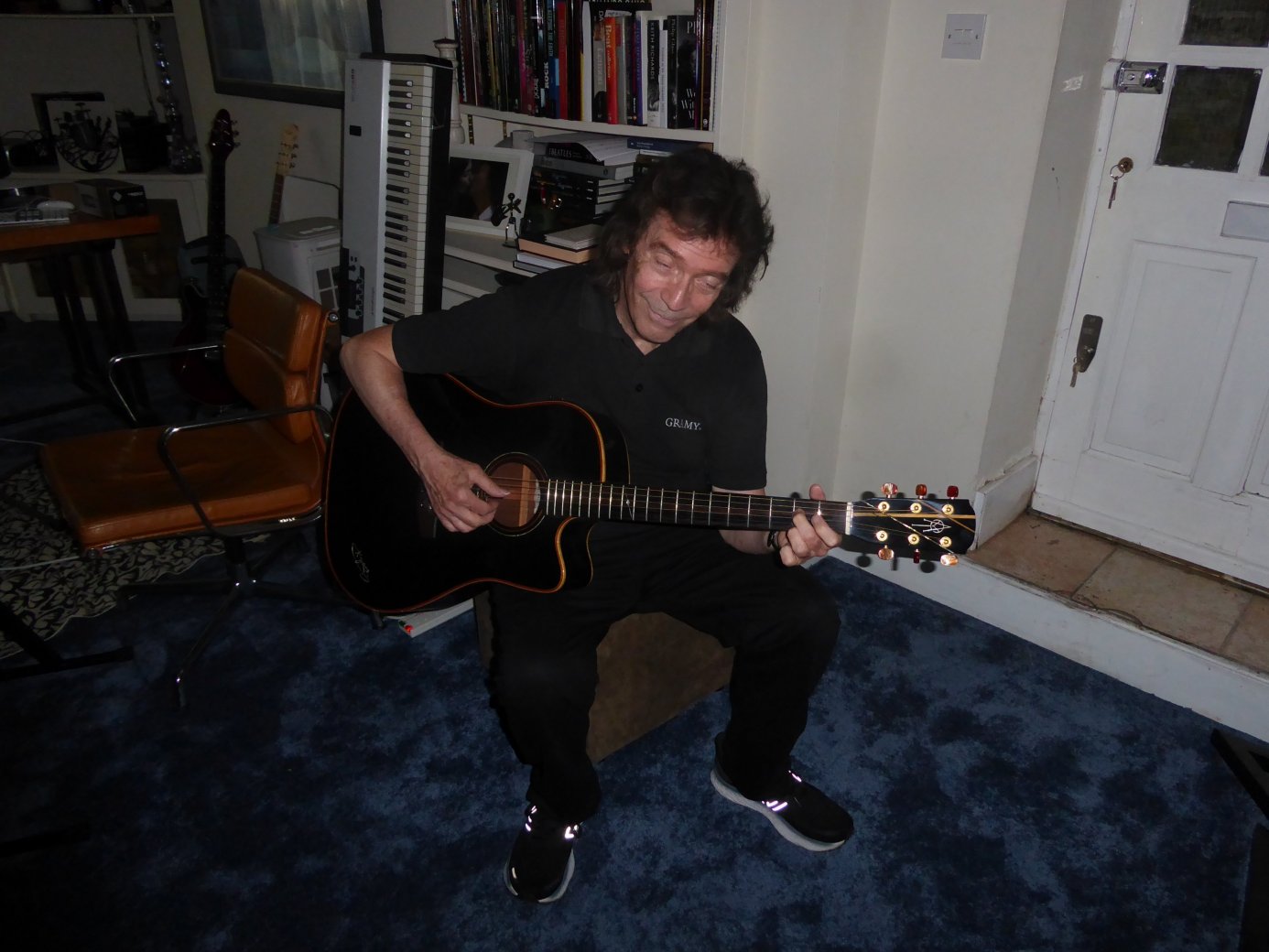
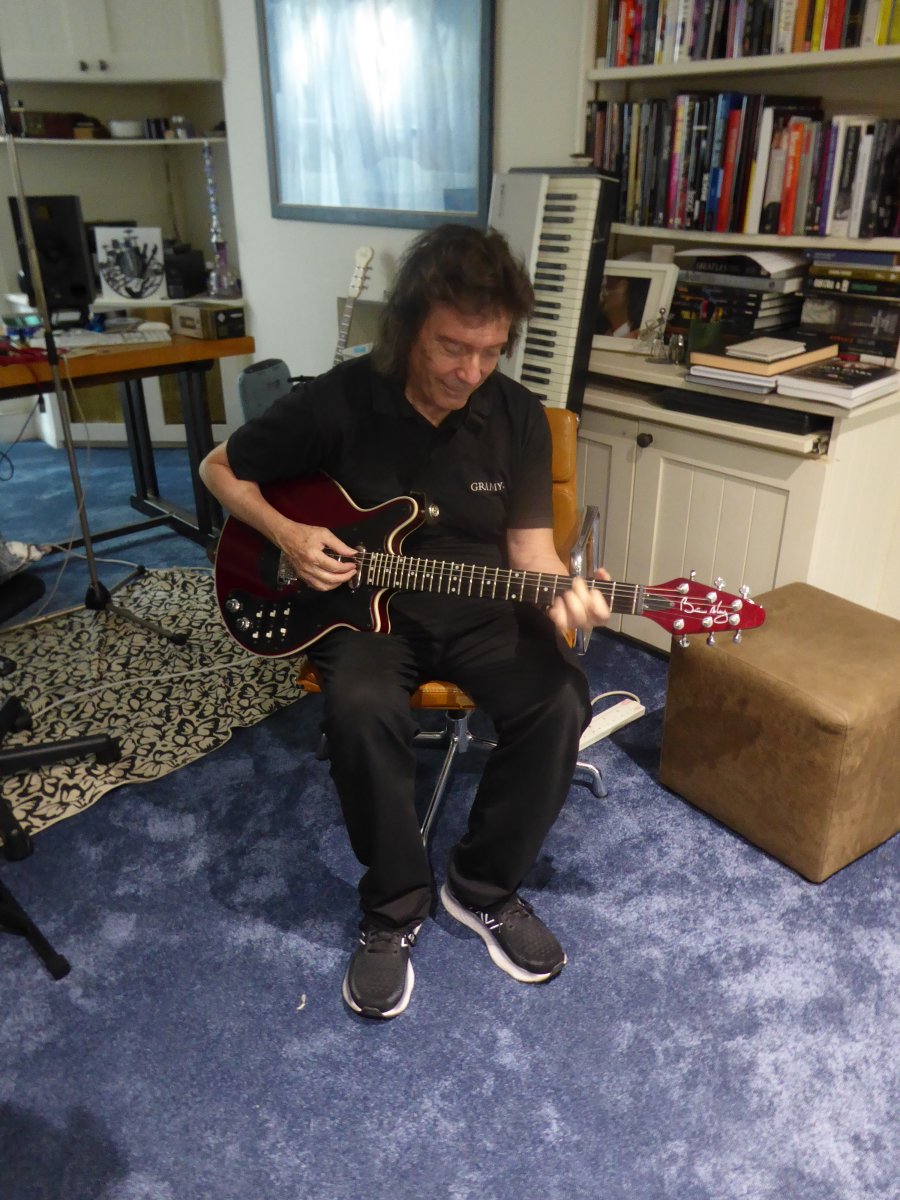
"Above the Roaring Waves" – Steve Hackett talks to TWR about his latest collaboration with Steve Rothery and his latest projects. Interview conducted at Steve's home on Tuesday 7th July. Photographs by Stuart Barnes, Jo Hackett and Alan Hewitt.
TWR: So here we are once more. I've heard that song title before … We are here to talk to you, first of all, about this new collaboration that you've got with Mr. Steven Rothery.
SH: Yes.
TWR: So I suppose the first question about that is, how did that collaboration come about in the first place?
SH: We basically were having fun jamming together either at the Marillion Studio, the Racket club, or at the place I had in Teddington. Eventually that incorporated the stuff that he did at home. And eventually we finished off everything here. Then we had it mastered at Abbey. Basically it sprang out of friendship. Our wives get on very well and they're both called Joe. So Steve and Joe go out to dinner with Steve and Joe, both guitarists.
TWR: It's like a Bruce's sketch really, isn't it? Do you mind if I call you Bruce, Bruce?
SH: I know it is. It really is. Or the island of Alan Wickers. Who could forget that?
TWR: That dates us all (laughter)
SH: I think that, doesn't it? Yes, exactly. You've got to know who Alan Wicker is in the first place to appreciate the full.
TWR: Don't worry, we';l put a footnote in about that.
SH: Thank you. Okay. For the over 70's (laughs) |
|
TWR: So how long ago did all of this start then? I mean, it's obviously taken a long time to get it together.
SH: Steve reminded me. Mr. Rothery reminded me that we started this eight years ago and we started recording, kicking around ideas. And the reason why it's taken that long is because we were both phenomenally busy with our respective bands and respective tours. It's been my busiest time since I was nine months at the stretch with Genesis doing Lamb Lies down on Broadway. The relentless tour schedule then has given way to all these decades later.
TWR: Plus ca change, plus c'est le meme chose...
SH: That's it. En francais. So. We had lots of fun. I was worried that it wouldn't coalesce into an album's worth of stuff, partly because there were these long gaps.But that meant that we had time to think about it and decide whether it was going to be a vocal album or an instrumental album. Guitarists we didn't have any trouble with. There were no mutinies in the ranks.
Yeah, unlike gtr, which was the other guitar pairing that I'd been involved with over the years, it was self funded. There was no record company to answer to. So when it was done. We said, basically, this is it and are you interested in it? Which is why Inside out came up with an offer for us. So that was interesting. I bet nobody was breathing down our necks saying, I don't hear a career song that isn't the kind of lyric that the great American public are going to subscribe to. There was none of that. It was just a couple of mates having fun doing music that appealed.
And with instrumental stuff, the ideas that were discussed were the idea of soundtrack, atmospherics, things that weren't being driven with the idea of producing songs as such, you know, because there is always the worry that when you're doing an album, and I should know this because I made enough in the past, you spend all your time trying to make a cohesive song and then you've got five minutes left to do the guitar work, which is the thing that people really want to hear from you. And so this was icing driven, if you accept my use of the word icing. Guitars being the last things that go on. There was no idea of verse, chorus, structure or that because it was instrumental.
TWR: So it is totally an instrumental?
SH: It's totally instrumental. There are a few oohs and ahs, but just basically a minimal amount of singing. Yeah, to repeat myself. It's an instrumental album. In many ways it reminds me in terms of energy, of when Fleetwood Mac did Albatross. And I didn't get it at first. First, because everything I wanted was fast, flash blues guitar, angry and all the rest. And Fleetwood Mac in those early days were painting a picture of something that. Here's a high flying bird Here's a rhythm that's the land or the sea the slow pulse of that pulse driven guitar's in harmony, Very beautiful, Very iconic. And you can't forget it because there isn't another track like that anyway. So I think that this is closer in spirit to that. It's not two American guitarists getting together to try and outplay each other by shaving nanoseconds off fast runs or salvos. I think I can bomb you out of your place. I can out tap you. No, it's not that. It's in a different gear entirely.
TWR: It's not competition, it's collaboration.
SH: Those are exactly the words that I used when I've done one other commentary on this. And I've done very few interviews thus far. I think I did about one thus far, so. And if you like, you can say this was an exclusive and no one's going to. No one's Going to gainsay you here. Or naysay the right word anyway. So I find myself being utterly lost for words except to say, well, you need to hear this to see why we gave it the titles we were. Now, Steve Rothery grew up near Whitby.
Let me say it's a seafaring album. So much so that both couples went there, stayed overnight. We looked at the ruined abbey which has the Dracula connection and there indeed was a storm in the middle of the night and my God, did you hear it? He said, yeah. Storms were part of his growing up.
It was part of his early life. We found that there were really ready made titles. British derring do titles we put to one side really with this, but the titles we came up with all relate in some way. So the ones that I'm facing. The storm speaks for itself.
Sands End. I do believe there is a place called Sands End and it's a description obviously of seafaring places where literally that's what happens. Red Dragon was the boat, the ship that was used with the East India Trading Company, apparently. Red Dragon. So that what the Roaring Waves is, the title of the album. Again, it's self explanatory in a way. It's perhaps more subtle than the title denotes, but somehow there's something very, very large about it. There's an acoustic introduction, which I do, and then there's something that's predicated on a melody that could have been done another way. It just so happened that we used guitars for it.
There are two drummers on the album. One is Italian Danieli Corno. The other one is Leon Parr who plays in Steve Rothery's band. I'll stick with titles. K109 refers to a Russian submarine where a number of them all went down and died. I don't know if that rings any bells and I can't remember how many.
TWR: A lot.
SH: A lot of them. I think it might have been 200.
TWR: That was one, if I'm not mistaken. That was one of their nuclear submarines.
SH: Yeah, I believe so, yeah. The Black Sea again, It's evocative. I love these seafaring titles.
TWR: So effectively what you're doing really is creating tone poems in a way?
SH: I think, you know, that's a word that's been used to describe classical music. Tone poems, indeed. I think it's music that Paints a picture. I don't think it sounds remotely like Genesis. I don't think it sounds remotely like anything I've done before. I don't think it sounds remotely like Marillion.
TWR: Well, that's the thing now going on a conversation between two people who are perhaps acting out of character. Obviously there'll be some recognizable sounds and trends, but. it doesn't sound like either of you. |
|
SH: Yeah, well, that's it. I like to think that when it works at its best, it's got a haunting quality to it. Certain melodies funnier. One that comes up in the Black Sea,.which has kind of got a wistful thing where you can't really tell if the guitar is played backwards or forwards. But it's in my case hitting the strings very lightly with one of the Fernandez guitars as you engage the string. So it grows rather light when you do backwards guitar. So you get. Instead of the decay at the end of the note, you get it at the beginning and then the note builds up to has a percussive end rather than of front to it. So it's that backwards forwards thing. Closest in spirit to perhaps sometthing I did years ago on Ripples. In the middle of the Ripples I had a backwards forwards thing.It was played forwards but there was a pre echo on it. But I digress. It's not about Genesis, but in a way. And that was a Synthi Hi Fli. Something like a similar effect is produced with the Fernandez guitars. And I'm not using that much distortion a lot of the time. It's just a little. So it feeds into the distortion and grows as it gets louder. So it's quite subtle use of electric. I'd say so given.
TWR: The fact there is two of you working on ideas.
SH: Yeah.
TWR: How does this. I'm trying to think of the right words for this. You come up with an idea.and Steve comes up with an idea how do you actually marry them together?
SH: Someone will normally have a riff or a pulse and the song will be built around that. I noticed when we did the Black Sea before it had a title that it had a very film noir feel about it. It had a slight John Barrie at his most atmospheric rather than furious. And I think John Barry was very good at those atmospheric. That coloured many of the movies, from the Bond things to the Ipcrest File to things that were and considered iconic by those who either do film music or have an appreciation of film music. Because film music is really the best forum for classical music. And if you're lucky, your film soundtrack may end up becoming regarded classic just because it happened to be arguably the best thing about Gone with the Wind, for instance, or the marvellous score that I'm sure we talked about before to the 1957 Ben Hur movie. This is not driven by the need to have orchestras.
TWR: For me, John Barry, I, I'm not a Bond fan, but for me, best John Barry soundtrack ever was for the lion in Winter. The opening theme scares the living daylight up. It's so powerful.
SH: But I think there were some damn good performances in that. And you think of the principles, of course, you know, Peter O'Toole and Catherine Hepburn, but you know, you've got, got, you got the others and they're not, they're not weak actors. It's not, it's not a list of, not a list of B characters at all.No, no, no, no. I mean, they're all really, really, really, really good. The only one I met was. The guy who was acting in TV stuff and I, and I met him through Ralph Bates when Ralph was alive and I told him how good I thought he was as an actor. Really, really good.And now, of course, Alzheimer's just around the corner. I've forgotten his name, but, you know. Yes, we know the guy did Bond after. Not Pierce, but the other guy...And it's the other chap who I thought was really good, who plays a kind of Agatha Christie type character in a TV thing at the moment anyway. So, yeah, that was quite interesting. I digress. But via Ralph, I got to meet all sorts of people, including Tommy Cooper and all the rest.
TWR: So it's very much a case of if you've got the main idea, you drive the piece or, or vice versa. And it's, it's a case of what can you bring into it and what can Steve bring into it?
SH: Only a snippet of an idea. Not like, oh, here's, yeah, here's the main riff and here's the second rhythm. But no, it would just be, you know, I had a rhythm that accompanies the storm, a one note rhythm. That's my main contribution to that. And maybe with the suggestion that. And chords could move around, that type of thing. And Riccardo Romano, who plays keyboard on this album and bass of some things, ran with the ball with that, so. And I've also been working with him outside the auspices of this. So he's been a real find for me via Steve Rothery.
That's been very interesting. But, you know, as a team, we've all been friends and there's been some very interesting stuff on this. There's been use of some Hurdy Gurdy. And I'm thinking of the Black Sea. Yes, of course. I said the thing about film normal and the spy genre, the idea of something from the murky depths in the way music that's existing in the shadows for an imaginary. An imaginary moment. All of those Orson Welles moments in the Third Man. And. The word tunnels comes to mind at the moment, tunneling under the music and what lies beneath the surface. And then there's the last track, because I'm not necessarily talking about them in order, but that's pure American Americana. It's. It sounds more like the Allman Brothers. And I know that Steve and I were very worried about this, that the Prog police will probably object mightily to the fact that we are just literally jamming.
And this harmonica. Heavens, you know, how unproggy can you get? But it's probably closest in spirit to something that might have cropped up on the Allman Brothers, a moment when they were out having a bit of, you know, Sunday afternoon bliss, you know, rather than the idea of, oh, let's perfect this, make sure that all the notes are right. No, it's absolutely honest. And it's like, oh, yeah, I'm finding my way.Well, not sure about that one. And left it all in. So, you know, there's the odd. There's the odd thing. So when I say the odd unfinished aspect to that.So that one denotes that.
TWR: What's that one called?
SH: It's called, if I've got the second word right, Pacific Highway. I think it is. I keep thinking of Pacific Ocean Boulevard, Pacific Palisades, but I don't think. I think it's Pacific Highway. Second word. Excuse me if I got it wrong. And you'd have to hear the album to find out how it works because there are a number of slow melodies that you then start singing to yourself because you're being haunted by it. Rather than being. Bludgeoned by salvo driven music, I'm mixing some military metaphors in here. It's. As I say, it's very different. And I mean the basic. It was very nice to do. It was very getle. Nobody was trying to knock me off my perch or.
TWR: So how long ago did you begin the project?
SH: It started eight years ago.
TWR: Eight years ago? How long, once you actually thought we're going to do something with us. How long did it actually do to take that basic nebulous idea? We had to make it something.
SH: We had these various get togethers over the years and then a lot of stuff came together very much at the last minute. Well, we thought, well, this track needs this, that needs this, that needs this, you know, we need to redo this, we need to do that, we need to polish this, etc. Etc. So I'm contradicting myself as regards Pacific highway that stands alone in terms of oops, I should have fixed that, but didn't. And the idea of, you know, we really must bring this ship in. Or else it could have. Could have been a 20 year hiatus, you know, undone. I think it was important to try and bring him.
TWR: The thing I think about, it is, we've. I've only heard one track from it. And the impression I'm drawing from that, which I think from what you've told us, I think will expand over the whole of the rest of the album is that it isn;t what the Hackett fans and the Rothery fans. ...We've all got our expectations. I think this one is going to take those expectations, put them in a box and say that's not what we're giving you because you're not. This is something entirely different.
SH: That's right. Yeah. It's, it's. I think if you want what Steve Rothery and I typically do separately with our respective bands, what have you, then. Yes.That's still there. He's touring, I'm touring. He's got at least two things on the go. I'm doing the occasional acoustic thing as regards gigs, but in the main it's electric gigs with a band that's got a couple of new, new members in it and it's been a blast working with them. So I'm looking forward to being out on the road again.
But that's, you know, that's. That's quite apart from that. We're here to talk about this. I'm proud of all of it. So I think it's very interesting because I think, you know, he's very high profile at the moment and I suspect that, you know, in a sense you never really stop paying dues in a business that always requires you to reinvent the wheel.
Every project and certainly this is a very different vehicle. You have to put your preconceptions aside and say this is a largely atmospheric album. I would say it was a series of paintings or tone poems with electric guitar. I'd never played so much electric guitar. Or even though I've been an electric guitarist for centuries, I've still not.
I've always resisted the idea of. Of doing an album that could have been called, you know, What is it they say with legalese? The truth, the whole truth of nothing but the truth. Yeah, the guitar., nothing.but the guitar. I've resisted that.
TWR: Well, you've always tried to explore different avenues...
SH: but this is different because. It's not even the kind of thing that you would expect from a Santana type thing. You know, when Santana played with John McLoughlin, we were all interested to see how that went. But again, it was rather less driven by the guitar pyrotechnics that we knew that John McLoughlin was gate from the north, but rather. Rather more driven by the iconic riffs that Carlos Santana is so very good at, and Jimmy Page, frankly, you know, riffmeisters.
So I'm very interested to see how people react to it. The. The video has gone ballistic in terms of responses, and I haven't checked today, But I think two days ago it was up to say, like 270,000 views. And I couldn't tell you what it is today, but I'll be interested to know.
TWR: The reaction seems to be value. I mean, once again, I love. I loved it. It seems to be good. Looking at the people in my little circle, my little part of the pond. |
|
SH: It's also positive, I think, in terms of equipment as well. You know, we're about to do something for Guitar magazine as well. Surprise, surprise. And there's that thing about, oh, well, I haven't used this bit of kit here. And he...I think Steve Rothery invests a lot in equipment and all of that. You know, it isn't just the cushions that say you can't have enough guitars, but guitars will do that. He does that. So, For instance, on that very track, the Black Sea, I was using an MXR phaser on it on fast and just letting the feedback from the guitar go. But then it was also going through an effect, a little tiny thing that does long echoes and things. And so you got this blurring and then there's some tail on it that comes in later. And I was listening back to it thinking, yeah, who did that? That's the sort of thing I Expect from keyboard players. No, that was you. You did that because you weren't playing notes, you weren't playing music.
What you were doing was atmospherics, because I wouldn't normally have used that sound. But because he was doing the arpeggiated figure that is the closest thing to a permanent fixture in the song, I thought, there's no point.
TWR: That's. That's a great little background to the album. I suppose the one question that a lot of people will be asking. Is is there any prospect of any gigs? Any gigs on the back of it?
SH: Yeah. Well, funny enough, he and I have been talking about doing another album which may have a different atmosphere entirely. And then perhaps at the end of that, we may have things that we can, you know, a set that we can take to people. There's already been an offer from South America in one place. Now, whether or not we'd be in a position to do that at the moment, I don't know. Or even next year, but maybe the year after that, because it does take time. Otherwise it'll be, you know, guys showing up doing either very familiar stuff or bluesing or jazzing out. And I think structure, such as it is, will become apparent by the time we've done another one of these albums. As I say, I'm not really used to doing group interviews. I can wax eloquent about all things solo.
I can say exactly where that's come from, where that comes from. So it's rather like doing a Genesis interview where you have to have a presiding view and you get more polished about being expert at selling your wares here. So. Yes. Well, you know my auto referential thematicsIt was done in a post industrial auto referential style. And my innate solicitude of specific conveyance precludes my ability to be able to describe it at all. It's the indescribable. So I want it to be not describable. I want it to have its own language.
And I would like other guitarists to do things in this vein where they aren't just falling into the trap of so much music and so much progressive music, if I may say so, and so much jazz is proficiency driven. This is not a competition. This is not proficiency driven. This is something else entirely. It's two people groping their way in the dark to try and find something cohesive. And I think we found some very interesting things. It's not predicated on all of that keyboard intensity in terms of things that are driven by chords as well. It's not that. It's stripping it right back and finding where you can apply certain techniques. Why would you do certain things?
So in terms of. In the past, whenever I've done something where I didn't quite know what I was doing, the things that I felt less sure about when I embarked upon them often ended up being the strongest things they'd ever done. And I suspect that this falls within that bracket.
TWR: Well, the great thing about instrumental music doesn't matter whether it's an orchestral is the fact that the audience uses its own imagination.
SH: Exactly. Yes. There you go.
TWR: So, we will move on from that. To briefly chat about. You just mentioned that, you know you're working on a new Hackett. Rock album and acoustic album. So. Yes. Give us a little bit of background to these works in progress...
SH: Yeah, work in progress. I think I finished this new rock album. We're going to be mastering it at Abbey Road again, same as the Roaring Waves. We're going to be working with Miles Scholl, who has mastered all sorts of things, things including back Beatle catalog and Genesis back catalogue. Because I was talking to him when we were doing Roaring Waves, I said, oh, you know, when we did Selling England By The Pound , we had one side that was 29 and a half minutes long. He said, I know, I've just mastered that again for you now. So I said, oh, I hadn't realised that you'd been involved with that, because I'm not in the driving seat with Genesis stuff. I'm not.
TWR: Who is these days?
SH: Who is now? You're quite right there. Who is with that? I mean, I certainly tried to drive it as much as I could when I was in the band, but I was the only one who was interested in being around for the mastering at that time. And fortunately, on side two, of Selling England By The Pound, if I can digress, there were lots of acoustic moments, so it meant that you could have that much on vinyl if you had lots of acoustic moments because it's bass frequencies that enlarge and deepen the grooves on vinyl. And I'm now, of course, making albums that are 45 minutes roughly in length because it has to fit with vinyl. So the only constraints are in terms of time. My new one comes out at something like 46 minutes. It should be okay to get two sides out of that without destroying anyone's record.
TWR: So, when I was here a few months ago you played us a few tracks from the new rockrecord which was a work in progress. Once again, I can't. Once again, I don't. I don't know whether he actually at the time had a working title. If so, I don't remember what it was. But of the three the one piece that struck me the most was the one that started acoustic And then went some. Somewhere completely different. Literally it was a case of he didn't just go off the beaten track, he went to another universe.
SH: There are some moments of that. I think, you know, we've discussed this sort of thing a lot in the past, but. The pan genre approach has been a calling card for quite some time. So I'd read something. It was a book on C.S Lewis, actually, and it was Lewis and I think it was Kingsley Amis and Brian Aldis all talking about writing. So this is in a book called of this and Other Worlds, a fascinating book which you've probably read already. You've read that. And there was a quote from Marcel Proust, And it was; One shows one's greatness by addressing two extremes simultaneously.
Good idea. Okay. And then when you look back over things that have been milestones in music, I think you'll find that they do precisely that. What was it that was so great about Revolver and sergeant Pepper? Well, with Revolver, the two extremes are on the A side and the B side of Yellow Submarine and Eleanor Rigby. There you are. Those are the extremes of. Yes, so they certainly did that. And I think the idea of Sergeant Pepper perhaps where they run with the ball yet further. And it seemed as if the whole world was on that record. The whole world was on the album cover. The whole world was on it. It was all the technologies they could muster. It was all the players.
Genres? Well, I think the Beatles are probably the closest in spirit because I don't think that music has been quite as inclusive before or since they did that. They defined that from your hometown (**Liverpool**). So I'm afraid it's a real thing.
TWR: Yeah. We always get the blame.
SH: Yes. There you go. But there you are. I mean, and so, you know, whatever they did, they certainly addressed those extremes about. Would have fallen within the same category.
TWR: And then on top of that, you also mentioned an acoustic project as well. Does it have a. Like, Under a Mediterranean Sky. Does it have a. It does A theme running through?
SH: It does, yes. But I don't think I should let that out. Because it's a title for. And then if I give away the title now, it may well be that I'll change the title. But I don't think so. I think that all I can say right now.
TWR: So, of course, if. And this is. And I know I'm speaking for a broad church of your fans here when I ask that if there is an acoustic album, would you consider acoustic tour? |
|
SH: The rock one is many and varied at the moment. It has six tracks on it, which is rare for me because I was normally doing something like 14 tracks or whatever. But it just so happened that as regards the rock album, each time we embarked upon something, the various teams, we found that it made it longer. That's not going to travel. I have been restrained. So the idea of the acoustic thing, I wanted to do a. I wanted to record Fra Avril playing something from an Alberto Noni oboe concerto. He played this piece of music to his bride when they were getting married and Roger did the soundtrack for him to play along to. And I thought it was very nice.
And I took a leaf out of Jan Garbarek's book with Officium, which is an album you may or may not be familiar with, but it was basically early sacred music. And he was doing answers to it as there were pauses on very underblown soprano sax. Not sounding like sax as we know it, but sounding rather like a medieval instrument. Very ambient, very wet, very churchy. And I thought, well, I could do something similar with this Abaddoni concerto and I could do some answers to the orchestral phrases.So you've got something that's from the 1700s. From 1720 odd and 2020 odd joining each other. Can't do the maths. Is that 400 years? That 300 – 400 years? Yeah, yeah, there you go. Three or 400 years a piece together. Very gentle. And it also incorporates the entire oboe part as well because it's very stately, it's very slow, It's. I mean, in a sense you could say in spirit.
It joins up with quite a lot of things that I've done with Steve Rothery, where the pace of that music isn't really set by dynamics as such. It's something else. It's closer in spirit to Adagio, but it predates all of that. It's Baroque, it's very processional.
If I was to look back over what one thinks of as the Albinoni work, very processional because he was a Venetian composer. It's got the same processional quality that you get with some Vivaldi pieces. It's very engaging. It's beautiful. It strikes me that it was an influence on Handel when Handel did the music for George III's Coronation Zadok The Priest, especially the interesting introduction, sounds like it's pure Albinoni. So this is what you get and it's that feeling of the sea journey again. It just feels like that it's processional, it's something of the sea. It's perhaps something of a decked out gondola. You know, it's that. And I find it very romantic. So this tie up between what was baroque music and often criticised for being overly mathematical, I just see it as very romantic, as indeed many of the pieces of Bach. It's quite wrong to say that he was a pure mathematician and not a romantic. All of that implied within it. Let's just say I thought very emotional. Yes. harmonies. I haven't done anything on my acoustic cabinet. I'm two tracks in and we kept it very, very gentle. It's very much relaxation music.
I had this idea years ago of acoustic music doing an album like Bay Of Kings, Momentum, where it was music for siestas. It was driven by the type of stuff that Segovia was doing towards the end of his life when he was slowing down a bit, and these majestic pieces. And so that was a big influence and still is. And also to try and conjure with the guitar, if not the orchestra, this idea of water and what that can do, whether it's rippling fast arpeggios, but it all becomes one, in other words, as if it was a solid mass rather than these things. So a bit like when you hear marimba being played or a roll on the drum, it becomes a continuous note because it's being played very, very fast.
So the effect is this moves and this moves and that moves rather than rivulets of sound coming at you. If I did tapping on electric guitar, it's. It's brutal. Yeah, okay. Yep. Combination punches. But on acoustic guitar, I think it's got entirely different things. So sort of swirly quality to it. That's all I can say was just, you know, the need to that also. Hammer in the Sand a few years ago, Nick Magnus said, I think we must have been thinking the same thing. I asked it to him because we always were friends and always having dinner. You know, it's a shame we never did an orchestral version of Hammer in the Sand. And Jo said the same thing; wouldn't it be lovely with real orchestra? And he (Nick) said, yes, I've done it. I've done it with samples, but with the idea of adding real to it to make it absolutely shimmer.
So once again, we went in with the one woman orchestra. That is Christine Townsend, the one woman orchestra. I tracked her up to such a degree recently on one of the rock tracks that there are 75 of her playing at once. So an orchestra of one. She didn't know it was going to be 75.
She did 25 while I had to disappear. And Riccardo was recording it. But I said, it's a repeat section. Why don't we have both those sections playing together? So he said, yes, put those together.And I said, and by the way, why don't we take it down the octave as well, have it in the region of basses and see if the whole lot will go down. Nothing phased. It was absolutely fine. Sounds like a massive string orchestra, which is what it is. So for the acoustic album, though, we're two tracks in and they both sound sumptuous.
They sound sumptuous. So, yeah, this is very different from the rest the rock album. I wanted to get as much orchestral texturing as I could on it because that band, what? You know, from Liverpool at one time you know, along with other luminaries in music with their involvement with George Martin, who sadly, I never got to work with.but I narrowly missed the chance to work with him at one point when I was heavily involved in Rock Against Repatriation. And I think I was trying to talk him into doing something for that. And he was talking to me about something based on one of the great writers?
And I was so fixated on trying to get this one thing done that. You bloody idiot, Hackett. You missed a chance of working with the great man. But I spoke to him a few times and we got to do A Midsummer Night's Dream in his studio, Air Lyndhurst, which was magnificent sounding and all the rest. So ask me another...
TWR: Well, now we'll move, because we are moving slightly backwards in time. We'll move back to The Circus And The Nightwhale, which I freely admit, you struggled with at first.It did not grow on me as I expected it to.
SH: Well, I'll try and remedy that in future.
TWR: Yes. You must hack it, otherwise you'll be on the naughty step.And I've only been thinking, obviously, I've only been thinking about this recently because I knew full well I was going to have the opportunity to talk to you. It's. It's about the timing of this album and the nature of this album. Because roughly at the same time, when you release this, you unleashed your version of the Lamb Lies Down On Broadway. So, you've got Peter Gabriel's Pilgrim's Progress. That's what he. I'm not convinced by that argument . And now we have what effectively is your own Lamb Lies Down on Boradway because that's the way I view this album. This is your personal. Oh, it's not personal. It's not couched in the obscure language that the pieces is. It's. It's easier to follow. Sure. Because obviously, I mean, for a start, you've got precise Sleeve notes. But given everything that's gone on over the last. Without mentioning certain people and everything else, given everything that's gone on, shall we say, in the last 20 years, did you think that it was actually, you know, your time to basically say, I'm going to tell my story? And then how did you actually go about thinking, yeah, I can tell my story, but given certain circumstances, how am I going to tell it?
SH: Well, two tracks were done, first of all, which were autobiographical, arguably autobiographical. And I ought to bring in Jo here, who said, why didn't you make the entire album autobiographical?
J H: Well, I thought it would be different to all the recent albums that Steve had done. And also the record company were agreeing with that idea as well. We spoke to them about it and. And Steve was in the mode of wanting to kind of express himself and look at his past and his memories, which had very recently come out of the book. And it was, in a way, like an accompaniment to that book as well.
It came out after, but it was a sort of musical version, in a sense, of an autobiographical thing. And also we talked a lot about how everybody's life journey is like a mythical life journey in a way, if you look at it in a certain way, and that's quite empowering. You can look at your life in that way and then you see yourself at your most sort of significance and it actually makes you feel more. What. Can I put it? As if your journey becomes more of a significant part of the journey in the world, because whatever happens to you and how you get through difficult times, how you get inspired by new ideas and all of these kind of incredibly important turning points in your life define you and define the part that you are playing in the world. You know, we're all responsible beings, both to others and to ourselves. And when you look at something in a mythical way, it somehow expresses that in a more powerful, colourful way than if you just talk about it in the prosaic. I did this. I did this, and that happened. So you can kind of give it more colour and feeling and atmosphere by doing it that way. So that was what we discussed between us.
TWR: This is just so raw. So did this hurt when this was being put together?Because it hurts listening to some of it...you know, you get. You get. Enter The Ring, Get Me Out, , they're almost... They're almost a slap in the face, musically and vocally... I mean, how. How difficult was it for you to try and, on the one hand, express that in the raw emotion that you wanted to get across without sort of letting it get out of control?
SH: Well, at least one of those came to life as a live track. And I noticed that it went down very well live. And that was Circo Inferno. Actually, it's Circo Inferno, isn't it? It's neither of those two tracks. I'm sorry because I haven't been looking at this recently so I'm not quite as familiar with. Yes, Circo Inferno was one but I would say that was pretty raw and. But because it's kind of gigantic live, it gave me an idea that the power chord or the power of the power chord was not dead.
TWR: Definitely not.
SH: And I've got a new one. Funnily enough I haven't recorded it, which is a power chord thing and I'm thinking yes, I think, think I ought to be using. Yeah, well what it would be vocally, I don't know but that'll be for another day.
TWR: Yes, I remember for me, obviously it's all for me. This album is one of impressions. Some things make an impression, other things don't. People of the Smoke made an instant impression on me because I know that's a reflection of your childhood, but it's also a reflection of mine because 10 years later Liverpool was exactly the same. I listen to that and I, I get the image in my head of a gray city.
SH: Yes, I'm very much aware of that. In the 1950s, of course, you know, it was a coal fired economy, that was it. And London was powered by coal. The heat, the light, the Battersea Power Station, all of that. And of course now today you can take the ride up the chimney, one of the chimneys.It can take 30 people. We've done that, we've done that twice. And you can look over the road across the Thames 70 years ago you could almost see my bedroom window but they've got a tree in the way now. See my 3 year old view up to the age of 7. Those 4 years had all of that.
TWR: I mean the line that literally slapped me in the face on people who smoke was a hanging at dawn while a baby is born.
SH: Yeah, we almost left that out because we. That was very strong. But it was Jo who convinced me to leave it in because it was, you know, that was the nature of what was going on at that time. I think, you know, we were still thinking in terms of post war and very much punishment for the guilty and what a violent world it was. And when I was at school, as I suspect you, you'd be taught by people who've managed to survive the Second World War and some of them the first.
And so yes, it's almost inevitable that there will be another conflagration and you will be expected to play your part in It. Which is why you must be very obedient and put up with all sorts of crap. But, you know, that was the prevailing notion. That was it. You know, boys comics were still full of Biggles Derring do, Death to the Hun,. Banzai to the Germans. Sorry to the Japanese. Yes, that might have been Banzai to the Germans. Still, in terms of entertainment, it was still the world at war very much. Whether they were post war comedies such as the Army Game, Bootsy and Snudge, which was a spin off from that.
TWR: We played our playground was. Was a piece of waste ground at the bottom of the street where two houses had existed which had been demolished during the Blitz. So, you know. The bullet holes were still there.
SH: Yeah. When you saw the word of Pimlico where I came from, I didn't understand. Understand why London was. Or Pimlico was in such bad repair. I meant rubble.And I had. You know, my young brain had no idea that, yes, giants have stomped through here, but there are so many. It's difficult for me to even ask the questions because there's just so much going on. I mean, for me, what were. When you actually putting this together, what became, if you like, the key tracks that became the spine on which everything else was fleshed out?
Well. Oh, goodness. Yeah. Maybe I should have it before. Look at the titles.People Of The Smoke opens the album. But was it the first track that came to mind? I think the very first track I worked was Wherever You Are. Think that was. That was really it. And the second one that I worked with was. Get Me Out. That one. I think it's that because I'm thinking of Enter the Ring. I think it's the rather long one, isn't it, which has got the various things in it and it's the most proggy. Perhaps Enter the Ring, Get Me out was rather more simple in a way, but all I can say is it was one that I thought really worked. That was. That was it. At the end of the day, again, this word noir comes in. You know, the influence of the Perry Mason theme.
It's practicing practically the Perry Mason theme, but with guitars and other things. It sounds very much like there was real brass used on that. But the real brass that we used was Mellotron brass. But by the time it Was tracked up with guitars, synths, organs, etc. It sounded like a very heavyweight band, so I was proud of that.
Wherever you are, I think was the first thing written. I was very pleased with it. Funnily . Roger did some brilliant drums on it originally, but I used Craig at some point. I like to restore a version if I ever do a best of with his original drums on it because they were really fat, even though they weren't real.They really suited the thing I really stomped. It was a stomp, basically. But it was a cross between a rock song and a love song for Jo. So I'm proud of it on both those levels. These passing clouds.
I think I was aware that I had a guitar or two that I'd inherited from Gary Moore and there's an area of. some of the things that he did that were kind of classic sounding, but slightly French sounding. Yes. slightly jazzy, but not , but memorable. Not straight blues. So. I was thinking about tone, exquisite tone. When we did it live, we made it longer. We gave it over to Rob to jazz it out.
And then when I came back to it, I tried not to play as fast and do all that business, but to just bring it back to the sort of Sidney Bechet like melody. Taking You Down. Right. It's been a long time since I've heard it. It started out with a guitar riff, I think, with a very slow repeat echo on it. And it was really about somebody who I knew at school who was a big influence, but not necessarily a good one. And Jo came up with part of the lyric with this. And she came up with such a masculine sounding lyric that I thought was almost impossible that anyone would think, you know, that the woman was right there when his boots hit the ground he was taking you down And I think if I'd gone all the way with this character and kept up with him and being his friend for life. There was one of our number when we grew up, we became teenagers and I said to him, oh, you know, we used to go swimming. Did you go swimming? Oh, no, I can't do that. I'm on pills now.
In other words, Purple hearts and black bombers. And he's trying to be cool. And there was a young kid called Brian who had a great voice as a choir boy. And he was also learning to play drums. He could do things that we couldn't on the one drum that he owned. And he didn't make it out of his teens . He died on heroin. And I thought, you know, that could have been me if I'd followed a certain path and it's so important in life and isn't it, to pull back from certain people who seemed like a good idea at the time, but then your paths go and you think, yes. What was it that. What was it that made us friends?Yeah. I mean, I've been wondering about that lately, about a few of the people who I went to school with. A With X, Y or Z? The answer I got myself. And she probably either be in jail or.So, you know, a few like yourself, probably a few narrow escapes, but. Yeah, but so much of that.
TWR: I think why that al. This album is difficult for me is because so many, so much of it resonates with me personally.
SH: Oh, that's interesting. Well, similarly, our hurdle onwards found and lost was you think you've found love and indeed, yes, you have, in a sense. Two young people consummate the act. But then there's this divergence again where, as I think I've said before, my first girlfriend, my first experience, I became heavily involved with drugs and took everything in sight. And I don't know if she's still alive or not these days, but she really wanted to go for a slow suicide, really. And why, I'll never ever know. But you could say a 60s casualty, you could say all sorts of things. It's an enigma. If I allow myself to feel too much about that. I still find it devastating.
And more than my own personal loss is the idea that someone who has all the qualifications, qual qualities of, you know, being able to pass exams, be very, very intelligent, be able to read fluently upside down, all sorts of things that. No way. Really, really quick and at least initially seeming very warm and thoughtful, that she never really made it to the point beyond going in for various drug cures or ending up in prison or this, that and the other. And I just think, you know, the drama of our own life was this sort of slide into something unthinkable. You know, it's like you see so many on flower and then you see them wither.
It's heartbreaking. It was heartbreaking. And so in a very short song, I Tried to write a little bluesy thing into the ring. I'd have to look at the lyrics again because, to be honest, I'm trying to remember.I guess it starts with Eel Pie Island, which is just up the road. Oh, hang on, hold on. Ghost Moon. It was the island. The island was Eel Pie Island. It was a place where we both used to go, although we were no longer together as a couple. And I always saw the island at night. It was Sunday night, it was always cold. But the music was incredible. It was usually John Mayall, if it was any good, and the young Peter Green. And that was exceptionally good. And you used to have to go over a footbridge to get there. Which presumably meant that they would have had to do that with equipment as well. |
|
Unless they had a bridge that. But I imagine they would just piled up something and wheeled it over. Bridge between worlds. It really was. And the fog and rain. Yeah, because it was freezing. I never saw the old hotel that everyone played at on the island, except at night. So it was always an apparition at night, twinkling. The sound of blues in the distance. It's not the first song I've written about that.And then it really moves on to smoking a lot and drinking a lot before Genesis happened. So these are all very personal things.
Well, that's the other. Musical chairs changing horses, wildfire burning through the fair.Being personal.
TWR: How did you draw the line between what you wanted to express and what you wanted to sort of. I don't really want to share this.
SH: Right. I don't have too many skeletons in the closet that I don't want to share. I'm okay with that. So. I've tried to be an open book post autobiography, so I don't dodge too many things, but.oh I don't know, you know, the idea of life is a carousel, old chum. You know, you've got that carousel walls don't touch the ground. And, you know, once I did eventually, you know, get on the Genesis merry go round. Yeah. My feet didn't touch the ground - literally, you know, away from home and some, you know, life as a traveler. And it still goes on now, you know, most of the time this is very rare. We've got. We've got some months off, unfortunately, we've got some operations to do, so it'll be recuperation time. But most of the time our lives I think of is essentially as not an off thing.
We are world travelers. We live out of two suitcases, hers and mine, him and her. Downtime. There's little downtime because it's finishing off on the album. Weekends. It's quieter at weekends. That's when. Yeah. So in a funny kind of way, we have a nice job, but in the sunny kind of way when we're at home.Very busy during the weeks, a little less busy at weekends. So it's kind of like that. Yeah.
The fool is a powerful card. With a tarot, you make a leap of faith. You don't really know why, but you do it. Even though there's danger. But you.You have to make a commitment. Joining Genesis was a gamble. Get Me Out was. This is painful stuff. This is what I think this relates most of all to my time with a certain person and being invalidated and. Feeling like one wasn't really. Not really in control of your own life. Feeling like you were owned. Celebrated publicly, but privately being negated. I mean, obviously, you've got and eventually ground to an absolute halt by certain beings whose names I haven't been mentioned.
There you are. Very good. Ghost Moon and living Love. It's really. It is very painful stuff. It really is. About the time when I realized I was in love with Jo and couldn't live without her. But until that moment, until I made that commitment because I was still trying to uphold an outmoded, outworn way of life with a former partner, I literally felt like a ghost. I felt life was going on around me, but I wasn't owning up to. To what I needed, because I felt like a slave who was owned by someone else.
And so when I gave in as snow melt descends I'm not wrong in saying that there was love without end was absolutely real with Joe. And when we were in Naples, we were looking up one day during the day that the moon was there, when it's a bright blue sky and the moon is completely white because it's still daytime and yet you can see the moon. And we ended up naming a ghost Mountain room. And Jo was saying something very touching to me. She'd been there with her father, exactly the same spot, in exactly the same spot where there's a sort of stone pier that goes out. And he said to you, I believe one day you'll be here with your children, happy, and you'll forget about your old dad. And of course, that. That moment that that spot was where I always thought about my dad. And although I've never met your father, I thought it was such a touching thing to say.And that was the point we saw the ghost moon pictures, but then this picture ( from the album booklet) wasn't from that moment. It was beautifully done. Jo took this picture. It's Richmond Bridge.
Yeah. So in a way, and it was me trying to break away, you know, hold on, my love I'll find a way to break these chains we'll have our day it was, you know, a lot of things. Being in Paris and hearing, you know, guys just sitting down, playing near Montmartre, Sacre Coeur , and, you know, just that thing of guitars in the sun with, you know, a few kids sitting down, one of them playing a guitar. How lovely is it? Someone was doing that. It doesn't matter what they're playing. It's just. It's a guitar and it's in the sun. So that ended up being Firebird. Guitars in the Sun.
It's a love song. That's a love song.
TWR: I mean, it's brilliantly expressed, but it's not an easy listen. But then again, I don't imagine that it's intended to be the song. It's. Well, no. The whole album, That's evident throughout this. Trying to strike that balance between saying what you feel and not trampling over somebody, even though in some cases the person that you were probably talking about, you wanted to trample over. But that's another story.
SH: Well, at the end of the day, when you don't actually. When you speak in a more poetical way youwrite music and lyrics that you're more poetical. It's not obvious who it is or what it is, but. But the feeling is very clear, the feeling behind it.
TWR: I mean, even though the words are poetical, some of them are still incredibly powerful. They're not. It's not genteel. Do you know what I mean? For what's actually packed into such a small space. So, you know, bravo to you for that. Because I can't have been easy.
SH: Perhaps. One can't with one album, encapsulate it. Which is why I do so many albums and am driven to do so, because there are different sides to music.
TWR: You started as someone who sort of watched your music from when you started as your own person, rather than as part of the Genesis machinery.Now I may. I may be completely wrong. So. Yeah, please, if I am, please tell me. But from Guitar Noir onwards, you started to speak about yourself.You started to tell. To say things. Something's bothering me. I'm gonna talk about it. Something's going on in my life. I want people to know about it. I'm going to talk about it. You may talk about it in around about fashion. But the way the things are expressed, there's no doubt what the idea behind them is more and more expressive about more and more things as you've gone on and on. And this I suppose is the final call culmination of it in terms of. This is your story, so you know, bravo for that.
And there we have it, a few thoughts from Steve about his latest and ongoing projects we hope you findit interesting. As always our thanks to Steve and Jo for giving up so much of their time during what is a very busy period for them both.